Published
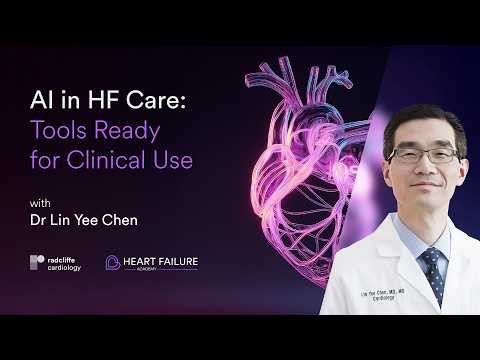
Dr Lin Yee Chen (University of Minnesota Medical School, Minneapolis, MN, US) joins us to examine which artificial intelligence (AI) applications in heart failure are ready for clinical use today, and which remain experimental.
As AI moves from research settings into the clinic, separating genuine clinical utility from hype has become a pressing question for heart failure specialists.
In this interview, Dr Chen sets out where AI-enhanced electrocardiography (AI-ECG) is already informing screening and risk stratification, most notably in detecting asymptomatic left ventricular systolic dysfunction before symptoms develop, and in identifying patients at risk of atrial fibrillation, a major driver of heart failure. Dr Chen also addresses the validation any new tool must satisfy before clinicians can rely on it: generalisability across populations, calibration as well as discrimination, freedom from subgroup bias, and explainability to earn physician trust.
Interview Questions:
In 2026, where is ECG-based AI already changing heart failure screening or risk stratification?
Which AI-derived rhythm or atrial signals do you currently trust most for flagging heart failure risk?
For a new heart failure AI tool, what checks around population fit, calibration, bias, and interpretability must be in place before you rely on it?
In the next two to three years, which AI applications do you expect to enter routine heart failure care, and which will likely remain experimental?
For a busy heart failure clinic today, which one or two AI tools clearly add value without increasing workflow burden?
If every clinic could adopt one AI tool for heart failure, which would you choose, and what is the biggest risk of using it uncritically?
Editors: Jordan Rance
Videographer: TBC
Support: This is an independent interview produced by Radcliffe Cardiology.
Visit Radcliffe Cardiology: https://www.radcliffecardiology.com/
This content is intended for healthcare professionals only.
Radcliffe brings medical knowledge, insight and innovation to life for CV clinicians around the world, using our communications & creative expertise, our platforms and connections across the community to help transform theory into practice faster.
Like us on Facebook: https://www.facebook.com/RadcliffeCardiology
Follow us on X: https://x.com/radcliffeCARDIO
As AI moves from research settings into the clinic, separating genuine clinical utility from hype has become a pressing question for heart failure specialists.
In this interview, Dr Chen sets out where AI-enhanced electrocardiography (AI-ECG) is already informing screening and risk stratification, most notably in detecting asymptomatic left ventricular systolic dysfunction before symptoms develop, and in identifying patients at risk of atrial fibrillation, a major driver of heart failure. Dr Chen also addresses the validation any new tool must satisfy before clinicians can rely on it: generalisability across populations, calibration as well as discrimination, freedom from subgroup bias, and explainability to earn physician trust.
Interview Questions:
In 2026, where is ECG-based AI already changing heart failure screening or risk stratification?
Which AI-derived rhythm or atrial signals do you currently trust most for flagging heart failure risk?
For a new heart failure AI tool, what checks around population fit, calibration, bias, and interpretability must be in place before you rely on it?
In the next two to three years, which AI applications do you expect to enter routine heart failure care, and which will likely remain experimental?
For a busy heart failure clinic today, which one or two AI tools clearly add value without increasing workflow burden?
If every clinic could adopt one AI tool for heart failure, which would you choose, and what is the biggest risk of using it uncritically?
Editors: Jordan Rance
Videographer: TBC
Support: This is an independent interview produced by Radcliffe Cardiology.
Visit Radcliffe Cardiology: https://www.radcliffecardiology.com/
This content is intended for healthcare professionals only.
Radcliffe brings medical knowledge, insight and innovation to life for CV clinicians around the world, using our communications & creative expertise, our platforms and connections across the community to help transform theory into practice faster.
Like us on Facebook: https://www.facebook.com/RadcliffeCardiology
Follow us on X: https://x.com/radcliffeCARDIO
- Categoria
- Cardiology
- Tags
- radcliffe, cardiology, vascular

Commenta per primo questo video.
Prossimo
-
10:32

Cardiac Failure: Pathophysiology, Clinical Features & Pharmacology | Mindmap| Episode 36: CVS Series
-
11:11
5 Common Causes of Heart Failure Every Young Doctor Must Know | Clinical Medicine Made Easy
-
11:19
രാത്രി ഉറങ്ങാൻ കഴിയുന്നില്ല Heart Failure ആകാം | Early Signs of Heart Failure | Dr. Madhu Sreedharan
-
18:07
11 Early Signs of Congestive Heart Failure (You Ignore Daily) | Symptoms Of Congestive Heart Failure
-
19:18
Stop Memorizing Heart Failure: Draw Left Ventricular Congestive Heart Failure Step-by-Step
-
17:42
STCCCV-2025-AI-assisted heart failure management:clinical applications and futuredirections-E lagha
-
10:32
Clinical Case: Cardiac Failure Explained with Mindmap | Episode 40: Cardiovascular Series
-
17:52
2 083 Heart Failure Systolic and Diastolic Heart Failure
-
08:10
“Heart Failure Minutes” (Episode 6) - “A national integration of implementation in heart failure"
-
19:50
10 Early Signs of Heart Failure After 60 (You Ignore Daily) | Symptoms Of Heart Failure
-
09:07
Cardiology for Beginners: Basics of Heart Sounds and Murmurs (with examples)
-
13:45
How to Become a Cardiologist | Cardiac Electrophysiologist
-
04:14

V 00592 Cardiology Fellowship Video Dr Vranian V5
-
05:17

Cardiology Fellowship at SIU Medicine
-
04:15

Cardiology Fellowship Program at Danbury Hospital
-
05:49

Practice Question: Cardiology #1, USMLE Step 1, COMLEX Level 1
-
04:07

Dr. Muhammed Raza on advice for Fellows interested in Interventional Cardiology
-
07:36
Congenital Heart Disease – Cardiology | Lecturio
-
05:18

Cardiology Fellowship at IU School of Medicine
-
04:36

What are different types of Cardiology Tests | SPS Hospitals