Published
#CancerEducation #Fenbendazole #MedicalResearch #Oncology #EvidenceBased
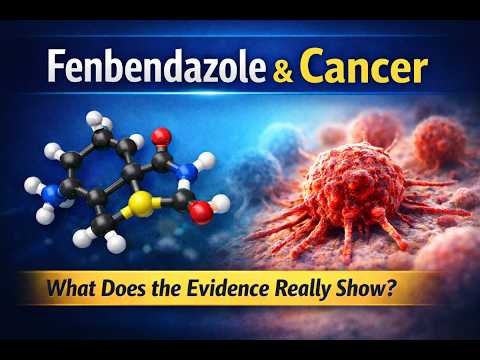
Fenbendazole, a drug traditionally used in veterinary medicine, has recently attracted attention for its potential role in cancer — largely through online discussions and anecdotal reports.
In this video, we explore what a new peer-reviewed 2025 case series actually reports about fenbendazole and cancer, and just as importantly, what it does not prove.
The paper describes three patients who independently chose to self-administer fenbendazole while living with advanced cancer. We break down:
What fenbendazole is
What the case series observed
The scientific limitations of case reports
Why caution and medical supervision are essential
This discussion is designed for healthcare professionals, researchers, patients, and the general public, using clear, evidence-based explanations without sensationalism.
⚠️ IMPORTANT MEDICAL DISCLAIMER
This video is for educational purposes only.
Fenbendazole is not approved for the treatment of cancer in humans.
Patients should never self-medicate and must always seek advice from their doctor or oncology team before making any medical decisions.
???? SOURCE (Peer-Reviewed)
Makis W., Baghli I., Martinez P. (2025)
Fenbendazole as an Anticancer Agent? A Case Series of Self-Administration in Three Patients
Case Reports in Oncology
???? KEY MESSAGE
Case reports can raise important scientific questions — but they are not proof of safety or effectiveness.
Responsible research, clinical trials, and patient safety must always come first.
⏱️ CHAPTER TIMESTAMPS
00:00 Introduction
00:30 Educational Disclaimer
00:50 Background of the Study
01:40 What Is Fenbendazole?
02:30 Summary of the Three Cases
04:30 What the Study Does Not Prove
05:30 Why This Matters Scientifically
06:30 Patient Safety & Medical Advice
07:15 Final Take-Home Message
#CancerEducation
#Fenbendazole
#MedicalResearch
#Oncology
#EvidenceBased
#PatientSafety
#HealthScience
Fenbendazole, a drug traditionally used in veterinary medicine, has recently attracted attention for its potential role in cancer — largely through online discussions and anecdotal reports.
In this video, we explore what a new peer-reviewed 2025 case series actually reports about fenbendazole and cancer, and just as importantly, what it does not prove.
The paper describes three patients who independently chose to self-administer fenbendazole while living with advanced cancer. We break down:
What fenbendazole is
What the case series observed
The scientific limitations of case reports
Why caution and medical supervision are essential
This discussion is designed for healthcare professionals, researchers, patients, and the general public, using clear, evidence-based explanations without sensationalism.
⚠️ IMPORTANT MEDICAL DISCLAIMER
This video is for educational purposes only.
Fenbendazole is not approved for the treatment of cancer in humans.
Patients should never self-medicate and must always seek advice from their doctor or oncology team before making any medical decisions.
???? SOURCE (Peer-Reviewed)
Makis W., Baghli I., Martinez P. (2025)
Fenbendazole as an Anticancer Agent? A Case Series of Self-Administration in Three Patients
Case Reports in Oncology
???? KEY MESSAGE
Case reports can raise important scientific questions — but they are not proof of safety or effectiveness.
Responsible research, clinical trials, and patient safety must always come first.
⏱️ CHAPTER TIMESTAMPS
00:00 Introduction
00:30 Educational Disclaimer
00:50 Background of the Study
01:40 What Is Fenbendazole?
02:30 Summary of the Three Cases
04:30 What the Study Does Not Prove
05:30 Why This Matters Scientifically
06:30 Patient Safety & Medical Advice
07:15 Final Take-Home Message
#CancerEducation
#Fenbendazole
#MedicalResearch
#Oncology
#EvidenceBased
#PatientSafety
#HealthScience
- Categoria
- Oncology

Commenta per primo questo video.
Prossimo
-
05:43

Optimizing post-CAR T-cell monitoring in lymphoma: evidence with the use of liso-cel
-
12:30
Cannabis and Your Heart: Shocking New Evidence Reveals Hidden Dangers
-
05:02
AHA 25: Lp(a) and ASCVD: Translating Causal Evidence into Clinical Practice
-
11:17
Mixed Evidence on Eggs and Heart Risk with Columbus Batiste, M.D.
-
07:00
Repurposed Antiparasitics in Oncology: Promise, Evidence & Caution - Part 1
-
06:54
Psychologist Dr Pujitha About Evidence of the Afterlife | American Doctor Dr. Jeffrey Long
-
08:30
Angiogram Evidence of Disease Reversal on Plant-Based Diet
-
07:46
High-Dose IV Vitamin C for Cancer: What the Evidence Says (Trials, Safety, Quality of Life)
-
17:05
How is AI transforming oncology care in 2026? From evidence to clinical practice
-
11:59
Metastatic CSPC: Clinical Trial Evidence Review | CME
-
09:07
Cardiology for Beginners: Basics of Heart Sounds and Murmurs (with examples)
-
13:45

How to Become a Cardiologist | Cardiac Electrophysiologist
-
04:14

V 00592 Cardiology Fellowship Video Dr Vranian V5
-
05:17

Cardiology Fellowship at SIU Medicine
-
04:15

Cardiology Fellowship Program at Danbury Hospital
-
05:49

Practice Question: Cardiology #1, USMLE Step 1, COMLEX Level 1
-
04:07

Dr. Muhammed Raza on advice for Fellows interested in Interventional Cardiology
-
07:36
Congenital Heart Disease – Cardiology | Lecturio
-
05:18

Cardiology Fellowship at IU School of Medicine
-
04:36

What are different types of Cardiology Tests | SPS Hospitals